 |
Guitar Lessons that work!
A Visual Learning Experience, Lead Guitar Made Easy
Includes Over 150 online guitar lessons - Become better today!
Welcome to Guitar Secrets
Guitar Lessons that work!

Guitar lesson 1 Guitar Lesson 2 Guitar Lesson 3 Guitar Lesson 4 Guitar Lesson 5
[ Sharps and flats ] [ Guitar Tablature ] [ Guitar Exercises ] [ Guitar Tuning ]
Learn all the guitar notes on the fretboard
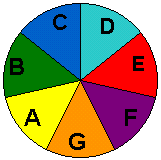
To begin our lesson, we are going to use colors to represent the guitar notes on the fretboard. Look below and notice the colors we will use to represent each note. A tone or note can be created in a number of different ways. For example, if you were to push down a single key on the piano, you would be playing a note. To play a note on the guitar, you would fret or push down on a string to create a tone or note.
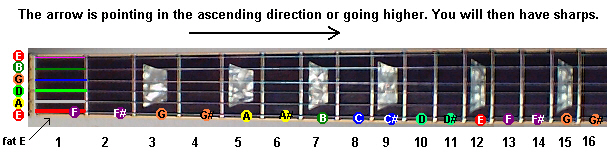
In this lesson, we will learn where each note is located on the guitar fret-board. The image below, illustrates a guitar fret-board and shows all the notes along the Low E string. The low E string is the thickest string on your guitar. The high E string, is the thinnest string
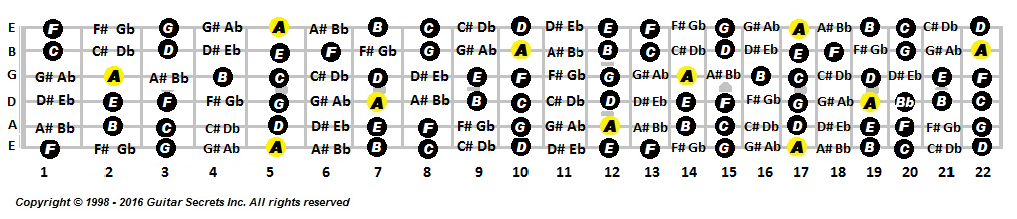
All of the guitar notes have been illustrated on the fretboard below.
The notes and each color, have been illustrated below. The 8 notes illustrated represent all of the notes in the key of C major. The key of C major is unique, because it does not contain any sharp or flat notes, which are called accidentals. As will be mentioned, if you were to play the piano, you could play the key of C major by using just the white keys. The sharp notes are represented by the (#) symbol. The flat notes are represented by the (b) symbol.
The black keys on the piano are the (sharp #) and (flat b) notes and are used to construct other major scales or keys. For example, if you wanted to play in the key of G major, you would use the notes of G A B C D E F# G. Notice the F#, it would be a black key on the piano. The key of G would contain one accidental or 1 note that is sharp. That note would be F#. The key of A major would have the notes of A, B, C#, D, E, F#, G# and A. Notice that there are 3 sharps in the key of A major. There would be 3 accidentals in the key of A major.
This information will be reinforced as we move through the guitar lessons and more information will be covered in the sharps and flats lessons.
C D E F G A B C We are going to move along the low E string and lay out each note on the fretboard. The Low E string is the thickest string on the guitar and creates the lowest note. The high E string is the thinnest string and creates a higher note then the Low E string. There will be twelve different notes that we need to learn on the guitar fretboard. After the 12 fret, all the notes repeat on the complete fretboard.
The 12 notes along the Low E string if you were ascending are: E F F# G G# A A# B C C# D D# and then E again at the 12th fret.
We will illustrate these notes and their placement on the Low E string. Look at the fretboard illustrationg below and notice the 6 notes to the left of the guitar fretboard. These 6 notes, represent the 6 strings used on the guitar. These 6 strings, when in tune, will be the Low E string, A string, D string, G string, B string and the high E string.
Look at the image of the guitar fretboard below and find the E note or the Fat E in red. The low E string will represent the E note when played open. If you pick the Low E string without fretting any note, you would be playing the E note. Of course, to create this E note, your guitar would need to be properly tuned. I recommend that you use some type of guitar tuner.
If you were to fret, or push down on the Low E string at the first fret, you would be playing the F note, look below and find that F note on the first fret. The next note, on the Low E string, at the 2nd fret would be the F# note. This is the (sharp symbol #). To get a sharp note, we would move 1/2 step above the previous F note. 1/2 step on the guitar, would be 1 fret. The E note will never be sharp. Look below and notice there is no E# note.
As we move along the Low E string, we reach the G note. Look above and find the G note at the 3rd fret. As we move up 1/2 step from the G note, or 1 fret on the low E string, we will reach the G# note, 4th fret. Find that G# note. The G# note is 1/2 step higher than the G note.
Moving along the Low E string, we reach the A note at the 5th fret. Moving up 1/2 step to the next fret, we have the A# note.
At the 7th fret, one whole step above the A note, we run into the B note. Don't forget, a whole step equals 2 frets on the guitar. Find that B note and notice that there is no B# note. You will never have a B# note. We will learn more about this when we learn constructing the major scales in that chapter.
The next note, at the 8th fret, will be the C note. Then we would have the C#, D, D# and finally to the E note again at the 12th fret. I say again, because on the guitar, every note repeats after 12 frets. To prove this, look at the G note on the 3rd fret, you will find the G note repeated at the 15th fret, 12 frets away from the 1st G note. Compare that to the remaining notes. You can figure out each note, on each of the six strings by using the same process as we did above.
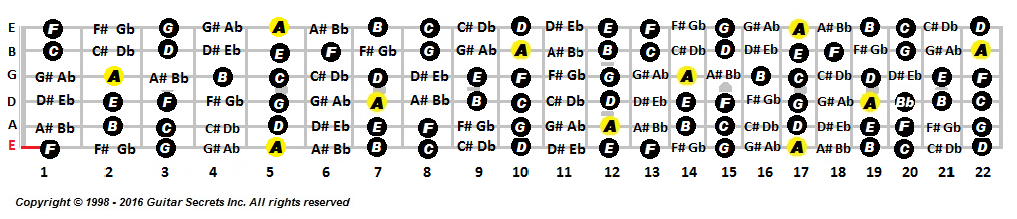
The image below now shows you how to find the notes along the A string. Look at the image below. The first note starts with the open A string, find that note. The next note, on the A string, 1st fret, will be the A# note; find that note. The next note is the B note. You can see that it continues as the Low E string did.
Each note is figured out the same way as we did on the Low E string. Notice there is no B# or E# on the A string. There never will be a sharp for these two notes on any string. Notice again, the A note is repeated after 12 frets. All the notes would repeat after 12 frets, this goes for every note, scale and chord.
The image below, shows all of the notes of the fretboard ascending. Ascending on the guitar fretboard means going up the fretboard or going to higher notes. Higher would be moving from left to right. For example, the F is higher than the E note. E to F, F to G, A to B is ascending.
It's very important to learn all the notes of the guitar fret-board and their placement. Use these blank illustrations to fill in all the notes of the fret-board. You can use the illustration below, that has all the notes of the fret-oard as a guide to help out.
Here's a secret. When you go higher on the fretboard you would have notes that are shart. But, when you go lower you will have notes that are flat. Look at the illusrtration below and notice there are sharp # and Flat b notes. Find the A# note at the low E stirng 6th fret. Notice that there's a Bb flat note nexts to the A#. The A# and Bb note are the same note. When you descend on the guitar fretboard, the notes will be flat. This is a little complcated now, but we will work on this later in the lessons. Just understand that there's sharp and flat notes. The E will never be sharp, but has a falt. The F is never flat but has a sharp. The B will have a flat, but never a sharp.
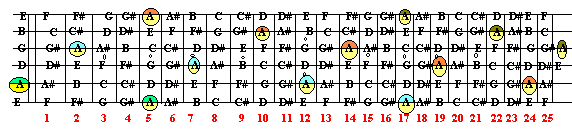
Look at the image below. This image has all the notes of the guitar, but the A notes are circled. Notice that some A notes have different colors. Playing each A note and its particular color, will sound the same tone. The yellow and green colored A notes are at a lower octave than the yellow and blue A's.
The yellow and blue A's are at a lower octave than the yellow and orange A's. Play each A note on the fretboard and compare to each other. This illustration will eventually become second nature.
Guitar lesson assignment:
- Use the illustrations you've printed out, to fill in all the notes of the fret-board, ascending. Use the image above to help out.
- Once all the notes are filled in, circle all the A, C, D, E and G notes. These are the notes of Am pentatonic scale, we will be learning this scale later down the road.
- Try to fill in all the notes on the fret-board from memory. Do this until you can do it without messing up.
- Then, use a blank illustration and fill in all the notes along both E strings. Try to fill these notes in from memory. Make a few copies of the blank fret-board illustrations. This is a great brain exercise and will help you visualize note placement.
- Begin to memorize the A and C note positions on the guitar fret-board.
- For your next lesson, study the Sharps and Flats lesson.
- Have any questions, drop us a line.
If this lesson helped you in any way, you should become a guitar secret's member and have access to A Visual Learning Experience, Lead Guitar Made Easy. You will find audio and video examples to help you become a well rounded guitar player. You owe it to yourself, become better today!
Good luck,
Guitar Secrets
Copyright 1998 - 2018 Guitar Secrets Inc. All rights reserved
Lead Guitar Made Easy, A Visual Learning Experience |