 |
Guitar Lessons that work!
A Visual Learning Experience, Lead Guitar Made Easy
Includes Over 150 online guitar lessons - Become better today!
Welcome to Guitar Secrets
Guitar Lessons that work!

[
[ Guitar chords ]
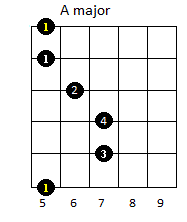
We will begin by explaining the open position E chord. The E chord is very important because its fingering pattern can be converted to the root 6, E type bar chord. You can use the E type bar chord fingering pattern to play many bar chords. The E type bar chord, is a movable major chord. You can play over 15 different chords by moving this root 6, E type bar chord to different positions of the guitar. The chord is determined by the 1 finger fret position.
The E type bar chord is a root 6 bar chord, which means the chord is determined by the note on the 6th string. Remember the 6th string is the Low E string.
Check out the image below. The notes on the low E string have been illustrated up to the 13th fret. Remember all notes repeat after 12 frets so you can continue after the 13 fret. If you used the root 6 bar chord fingering and moved your 1 finger to the 7th fret, you would be playing the B major chord. If you moved that same fingering pattern to the 3rd fret, you would be playing the G major chord
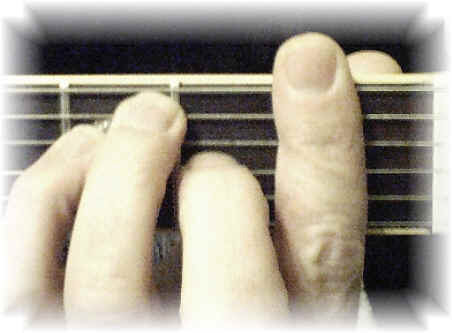
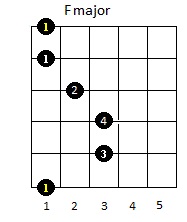
The open position E chord is shown below. The second image below is the F major chord, root 6, E type bar chord. Notice the index finger of the F bar chord is played on the 1st fret and the other fingers have the same fingering pattern as the open E chord. The note on the first fret, Low E, 6th string is the F note. Look below. That's where the E type name comes into play.
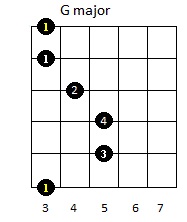
I've illustrated 3 root 6, E type bar chords below. The chords are F major, G major and A major.
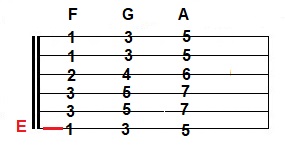
The tablature has been included below for the F, G and A root 6 bar chords. Practice each of these chords until you can play them cleanly and can move around freely. Once you learn these chords, begin to move all around the fretboard. Try to memorize all the notes of the Low E string.
Guitar bar chord secrets. Here’s a video explaining root 6, root 5, E and A type bar chords. You will learn to play these bar-chords up and down the guitar fretboard.
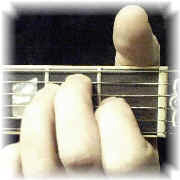
Look at the image below and notice the F note at the 1st fret 6th string, or Low E string. Now notice the index finger to the left covering that fret. Since the index finger is on the 1st fret F note, it is now the F chord.
If you moved this same fingering to the 3rd fret it would become the G chord. Look above and notice the note at the 3rd fret Low E 6th string. It is the G note.
Moving this fingering to the 8th fret would be the C chord. The 10th fret would be the D chord. Remember I told you earlier that everything repeats after 12 frets. That goes for scales and chords too.
This type of bar chord is determined by the note on the 6th string which is the Low E string. Root 6 bar chord
Now you have learned that you can easily convert the open E chord to the movable bar chord and play over 15 different chords on the guitar. The root 6 or E bar chord is determined by the note on Low E 6th string. Play this chord in every fret possible along the Low E string and note which chord it would be. More root 6 minor and major bar chords. Use these bar chords to play a progression.
Good luck,
Guitar Secrets
Copyright 1998 - 2019 Guitar Secrets Inc. All rights reserved |