 |
Guitar Lessons that work!
A Visual Learning Experience, Lead Guitar Made Easy
Includes Over 150 online guitar lessons - Become better today!
Welcome to Guitar Secrets
Guitar Lessons that work!

[C major modes] [ C Ionian ] [ Dorian mode ] [ Phrygian mode ] [ Lydian mode ] [ Mixolydian Mode ] [ Aeolian mode ] [ Locrian mode ]
[ Basic major scale fingerings ] [ F major modes ] [ G Modes ] [ Constructing Scales ] [ Key Signatures and constructing major scales ] [ Modulation, cadence, progressions ]
Dorian mode and the modes of C major
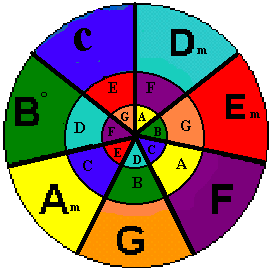
The next mode that you need to learn is the Dorian mode. The Dorian mode in the key of C is the second mode. The Dorian mode is the second note of any major key. Look below and notice that the second note D is a minor chord, so this is a minor mode. The Dorian mode is a popular mode as are all the minor modes. These modes give that darker, sad minor sound. The major modes give that happier sound.
- In the previous lesson we learned the Ionian mode, which is C to C in the key of C major. C is the first note in the key of C.
- Now we have to learn the Dorian mode, which is played from D to D in C major. D is the second note of the key of C and is a minor mode.
- The second chord of any Major key is always a minor. It is also always the Dorian mode. In the Key of G, A would be the Dorian mode.
- Remember, all major keys are constructed the same. Major, minor, minor, Major, Major, minor, diminished and Major.
D E F G A B C
To play the Dorian mode you would play from D to D in C major. The notes would be, D E F G A B C and D.
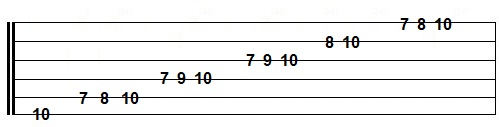
Look at the image below and notice the fingering pattern. This fingering pattern is a little different and recommended to learn. The D notes are now highlighted below. To play this mode you would start at the 10th fret Low E string 4 finger, this is the D note. The next note played would be on the A string 7th fret 1 finger. The next two notes are still on the A string 2 finger 8th fret and 4 finger 10th fret. You would then move to the D string 7th fret 1 finger. The next note is also on the D string move your 1 finger up to play the next note also. The next two notes are on the D string 2 finger 10th fret 4 finger 12th fret.
Move to the G string 1 finger 9th fret, 2 finger 10th fret and 4 finger 12th fret. The notes on the B string are 1 finger 10th fret, 3 finger 12th fret and 4 finger 13th fret. The last note is played on the high E string 1 finger 10th fret, this is the D note.
Guitar tablature below.
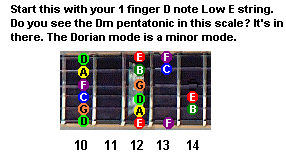
Look at the image below and try to memorize the notes and their placement. The D Dorian mode notes are illustrated below. The image above shows the same scale with the fingers that play each note. Notice the D notes are highlighted. Remember to play from D to D. Try to find other places to play from D to D. I use to draw out the fretboard and lay out all the notes on each fret in the key I was practicing.
Look at the image below. This is the Dorian mode with a different fingering position. Remember to play from D to D. If you look closely, you may notice another root note fret position.
Remember the Am root note fret at the 5th fret? Well you are now seeing the D minor pentatonic Root note fret at the 10th fret. If you're not sure of the A minor pentatonic root note fret, please go back and review. Things are really starting to fall into place and I hope you're not missing out. This means you can also play Dm pentatonic at this position.
Guitar tablature below.
So far we have covered the first two modes of the key of C major. The first mode was the C Major Ionian mode and the second was the D minor Dorian mode.
The C major Ionian mode is played from C to C. The D Dorian mode is played from D to D in the key of C. This is a minor mode. You can play this mode over the Dm chord. You can base your song in Dm and use the Dorian mode. The notes and chords would look like, Dm Em F G Am B dim C. The notes are the same as in the C major scale, but you would be now starting with the D note.
Lay down a Dm chord, Am chord and F chord and play this mode over the chords. Try to play over each chord separately. Play the Dorian mode above over the Dm chord, but concentrate on the notes of the Dm chord, D, F and A. Play in the same position over the Am chord, A, C and E or jump to the fifth fret and play Am pentatonic scale over the A minor chord. You can actually play Am pentatonic in the position above. Look at the image above and recall the Am pentatonic starting at the D note 10th fret. Do the same over the F note, F, A, C. When playing over this chord use Dm pentatonic or play from F to F in the image above. F to F is the Lydian mode. Or even play F Ionian over this chord. Remember if you have a major chord, you can use a major scale. If you have a minor chord, you can use a minor scale. Knowing which one to use is what you will be learning.
The next lesson covers the Phrygian mode. The Phrygian mode starts at the third note of a Major key. The third note of C just happens to be an E or Em chord. So the next lesson covers the E Phrygian mode which is a also a minor mode.
Remember, all major keys are constructed the same. Major, minor, minor, Major, Major, minor, diminished and Major.
Good luck,
Guitar Secrets
Copyright 1998 - 2019 Guitar Secrets Inc. All rights reserved |