 |
Guitar Lessons that work!
A Visual Learning Experience, Lead Guitar Made Easy
Includes Over 150 online guitar lessons - Become better today!
Welcome to Guitar Secrets
Guitar Lessons that work!

[
[ Guitar chords ]
Open position guitar chords
Open position guitar chords get their name from the root note of the chord. For example, the root note for the open position E chord would be the Low E note. This E note would be the open Low E string or 6th string.
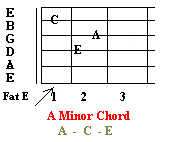
The root note for the open position A minor guitar chord would be the Low A note and would be the open A string or 5th string.
Look below at the guitar chords. Notice the (0's) next to the strings. The (0's) shown next to the strings will be strummed open or not touched. When playing the A minor chord strum from the open A string down through the rest of the strings.
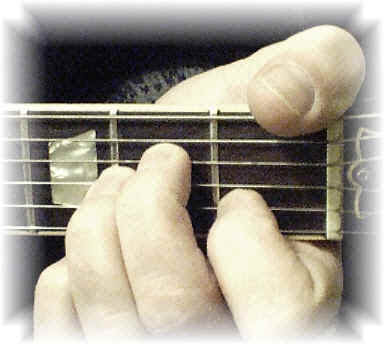
Once again the A minor chord is made up of the A - C - E notes. Look at the images below. The first image shows the A minor chord with the fingers that play it and the second image shows the notes of the A minor chord. The open strings are the A, and high E. Once again these open strings are not fretted, but strummed along with the fretted notes. Also notice that the open strings are part of the A minor chord, the A string (A note) and the high E string (E note).
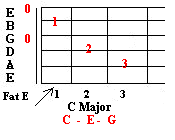
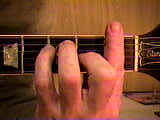
The 1 finger is on the first fret B string. The 2 finger is on the second fret D string and the 3 finger is on the G string second fret . Play this chord and try not to touch the strings that are left open. Listen to the E guitar chord
The C major Chord is to the left. Fingers and the notes are shown. Practice this chord. It may take you some time to get comfortable with this.
Listen to the C chord.
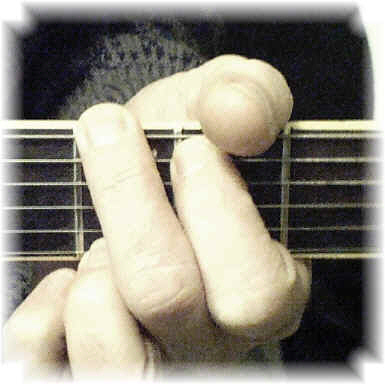
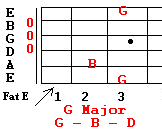
The G Chord is to the left. Once again practice this chord until you have it memorized. Hold each note firmly, but try to stay relaxed.
Listen to the G chord.
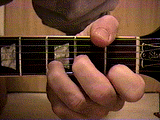
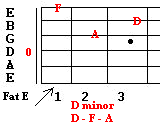
The D minor chord is shown below.t. The first image shows the fingers and the second shows the notes. I personally use my 4 finger, but you can use your 3 finger.
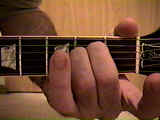
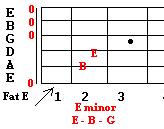
The E minor chord is shown below. The first image shows the fingers that play it and the second image shows the notes that make that chord up.
The notes that make up the E minor chord are E - B- G. The open strings are the E, G, B and E string. Those notes are left open and played because they make up the E minor chord.
Listen to the E minor chord.
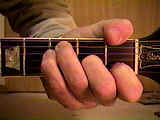
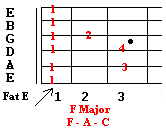
The F chord is illustrated below. The first image is showing you play the F with the thumb on the Low E string. The second image is barring the complete 1st fret with your one finger. This is the root 6 E type Bar chord. The Low E string determines what chord it will be. This is also a movable bar chord. You can move this fingering all over the fret board to play different chords. If you moved this fingering to the 3rd fret, it would now be the G chord. If you moved it to the 5th fret, it would be the A chord. 7th fret, B chord, 8th fret C chord, 10th fret D chord and so on. The note on the Low E string determines what chord it is. We will learn more about bar chords a little later on.
Notice that you can bar this chord. Your 1 finger covers the entire 1st fret from the 1st string to the 6th string.
Notice the chord above how you can play this chord with your thumb on the Low E string.
Once you have these guitar chords mastered, we will use them for our background rhythm. We will then begin to play lead guitar over each chord. Each of the chords illustrated above are from the Key of C major. If you were to write your song in C, you could use these chords to get started.
When you become a member or order A Visual Learning Experience, you will have access to printable progression charts, scales and much more.
The next thing I would like for you to learn will be hammer-ons, pull offs and bending. hammer-ons. Just a tip, you may eventually want to lay down your progressions on a recorder so you can improvise over them.
Good Luck,
Guitar Secrets
Copyright 1998 - 2019 Guitar Secrets Inc. All rights reserved |