 |
Guitar Lessons that work!
A Visual Learning Experience, Lead Guitar Made Easy
Includes Over 150 online guitar lessons - Become better today!
Welcome to Guitar Secrets
Guitar Lessons that work!

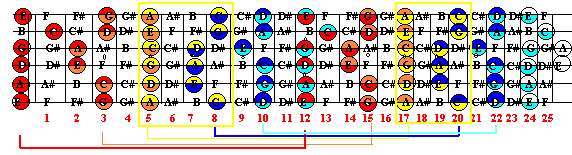
[ A minor pentatonic root note 5th ] [ Am pentatonic C note ] [ Am at D ] [ Am at E ] [ Am at G ] [ Am root 17 ] [ Am open ] [ Am at the G ]
In our last lesson you were asked to circle all of the notes of the Am pentatonic scale. The notes of the Am pentatonic scale are the A, C, D, E and G notes. This is a good exercise to become familiar with each note and placement. I took it one step further and have colored in each position of the Am pentatonic scale. We will eventually learn all of the Am pentatonic positions, but the root note fret in the yellow position and the blue position is what we will continue to work on.
Look at the illustration above and notice how the notes repeat after 12 frets. You can count from any note, and notice 12 frets away on the same string, the note is the same. This means that the scale patterns also repeat after 12 frets. Look at the root note fret in yellow. The notes are the same on the 5th fret as they are on the 17th fret. The root note at the 17th fret is exactly the same as the 5th fret. You can play a lead at the 5th fret and play a lead at the 17th fret using the same fingering. That is true for all of the positions. Look above at the C note on the 8th fret, it's the same as the C note at the 20th. Check out all of the notes and try to comprehend this.
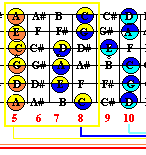
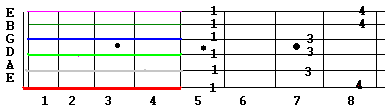
In the last lesson you were asked to fill in the next position of the Am pentatonic. This position starts on the C note, 8th fret. Look at the illustration below.
This position starts on the C note, 8th fret. The C notes are highlighted in blue. This would be a good place to learn to play over the C chord.
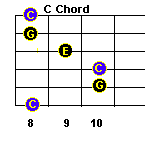
The illustration above shows the notes now for the position on the 8th fret. The image above shows the recommended fingering for this position. I mentioned this would be a good place to play over the C chord. I would like to show you how to do that.
The notes that make up the C chord are C, E and G. The chord illustrated above is the Root 6 bar chord. The note on the Low E string determines the chord. Notice how the C chord fits over this pattern. Try to play the C, E and G notes only, 1 at a time. Then strum the C chord and play from C to C. Play the Am chord and play from A to A or just the notes of the Am chord, A, C, and E. Begin to visualize each pattern and the chords that lie under each pattern.
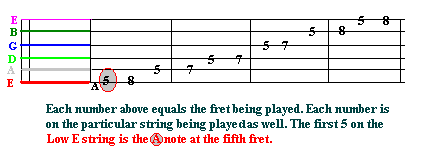
Guitar tablature is a way of reading music other than the traditional way. You don't read notes, but you read numbers that represent the frets and strings being played. Each number is on the particular string and fret being played. Have you ever bought a guitar music book, brought it home an wondered how anyone could learn from it? Join the crowd. Tablature offers everyone the opportunity to learn how to play music. You must learn this material before moving any further.The illustration belowt shows the Am pentatonic scale root note fret written in tablature. Notice the A note on the Low E string 5th fret. That's the A note on the 5th fret next to the circled 5
Compare the illustration above to the one below. The illustration below should look familiar to you. It is that famous Am pentatonic scale at the root note fret. You should practice this scale every day.
This is the exact same scale as above, but this one shows the fingers that play it. The one above has the number of the fret to play on that particular string
It is very important that you memorize the illustrations above. The Am pentatonic scale root note fret fingering is always 1-4, 1-3, 1-3, 1-3, 1-4, 1-4. This is also the same fingering pattern you would use to play other minor pentatonic scales. For example you would use this fingering pattern to play Bm pentatonic starting at the 7th fret. You would also use this fingering pattern to play Em pentatonic starting on the 12 fret. This is true for every minor scale and it's root note fret.
If you memorize this fingering pattern, you won't have any problem playing it when written in tablature. You will automatically know which fingers to use on that particular fret and string.
Now everyone needs to go review the tablature chapter.
Assignment:

In our last lesson you were asked to listen to the song I've begun to write. Slow3.wav. The tab for this song can be found below. Practice this song and we will continue to build on it.
Am F and G happens to be one of the most popular progressions for the Am scale.
If this lesson helped you in any way, you should become a guitar secret's member and have access to A Visual Learning Experience, Lead Guitar Made Easy. You will find audio and video examples to help you become a well rounded guitar player. You owe it to yourself, become better today!
Good Luck
Guitar Secrets
Copyright 1998 - 2018 Guitar Secrets Inc. All rights reserved |