 |
Guitar Lessons that work!
A Visual Learning Experience, Lead Guitar Made Easy
Includes Over 150 online guitar lessons - Become a member today and learn right!
Welcome to Guitar Secrets
Guitar Lessons that work!

[
[ Guitar chords ]
C |
Dm7 |
Em |
F |
G7 |
Am |
B dim |
C |
1 |
2 |
3 |
4 |
5 |
6 |
7 |
|
I |
ii |
iii |
IV |
V |
vi |
vii |
|
Tonic |
Supertonic |
Mediant |
Subdominant |
Dominant |
Sub-Mediant |
Leading tone |
|
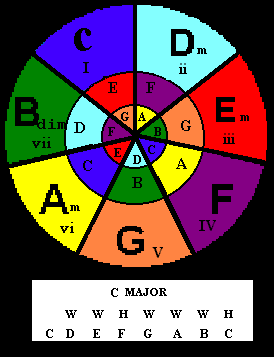
To use the illustration above, you must understand the numbering system. Look above and notice the number under the C. You will note the number (1) and also the roman numeral (I). Each note of the major key has a number to represent it. The C =1 or I, the D = 2 or ii, the E =3 or iii, the F = 4 or IV, the G = 5 or V, the A = 6 or vi and the B = 7 or vii.
You can use the lower illustration to play a number of different progressions. I would like to explain the blues progressions !, IV, V, which is one of the most popular used. In the key of C the chords would be C, F and G. Look below at the 1, 4 and 5 chords. The 1, 4 and 5 guitar chords are the C, F and G. Roman numerals are usually illustrated to show each note of a particular major key. It would be a good idea to become familiar with this technique. The small letters, (ii, iii, vi) represent the minor chords. Look below at the Dm, Em and Am guitar chords.
|
C |
Dm7 |
Em |
F |
G7 |
Am |
B dim |
C |
|
1 |
2 |
3 |
4 |
5 |
6 |
7 |
|
|
I |
ii |
iii |
IV |
V |
vi |
vii |
|
|
Tonic |
Supertonic |
Mediant |
Subdominant |
Dominant |
Sub-Mediant |
Leading tone |
|
|
Here are some chord progression units in Major Keys, (Chords are Triads). |
||||||||||||||||||||||||||
|
{ I
V I V}
|
You can play these progressions in every major key. The key of C has been illustrated, but play them in other keys. |
{ I V
IV I}
|
||||||||||||||||||||||||
|
Here are some chord progression units in Major Keys, (Chords are Triads). |
||||||||||||||||||||||||||||||||||
|
{ I
ii I ii}
|
You can play these guitar progressions in every major key. The key of C has been illustrated, but you can convert all of these chords to other keys. |
{
I ii
iii V}
|
||||||||||||||||||||||||||||||||
|
|
The progression below is a blues progression using the following chords. I IV V I Look to the left and find those chords. You should have noticed that the roman numerals above, represent the C, F and G chords. So to play this progression, you could strum each of those chords. |
|
Major Chord Formulas
|
(9) = 2 |
|
Minor Chord Formulas
|
seventh------------1, 3, 5, b7 |
|
Copyright 1998 - 2019 Guitar Secrets Inc. All rights reserved |